“Dust Cartographies: Blackburn, Nottingham, Chernobyl“
Masimba Hwati & Paul Nataraj
TX: Sunday, 6 September⋅6:00 – 6:20pm
Tuesday, 8 September⋅12:00 – 12:20pm
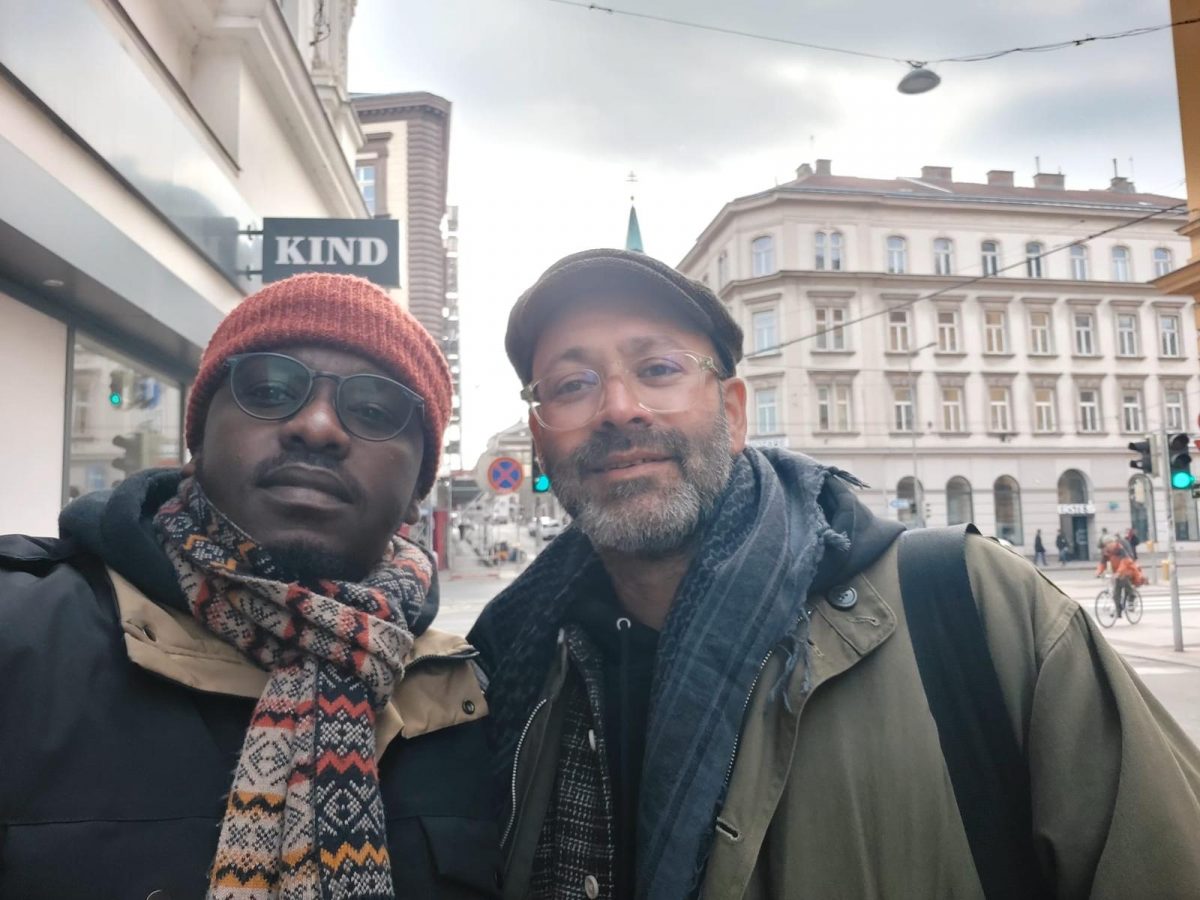
Dust Cartographies brings together two live performance activations that took place between 2021 and 2025 at the Cotton Exchange Building in Blackburn and Nottingham Contemporary. Emerging from an ongoing dialogue between Paul Stan Nataraj and Masimba Hwati, the work grows out of years of conversations on sound, migration, Indigenous ecological knowledge, ritual, and the politics of belonging.
Gathering fragments of these exchanges, the piece maps a sonic cartography of dust—as residue, witness, and archive. Moving between Blackburn, Nottingham, and Chernobyl, it traces the intertwined afterlives of industrialization, colonial extraction, and ecological damage, revealing how distant landscapes remain connected through shared histories of labor, contamination, and loss.
Interwoven with these broader histories are intimate reflections on friendship, migration, ancestry, and the search for home. Through voices, field recordings, and resonant silences, Dust Cartographies invites listeners to hear dust not as debris but as a material that carries memory across places, binding damaged landscapes and lived experience into a shared act of listening.
Paul Stan Nataraj is a British artist, researcher, educator, and sound practitioner based in Blackburn, Lancashire. Working across sound, installation, performance, writing, and archival research, his practice investigates the entangled relationships between memory, materiality, migration, and postcolonial identity. Through field recordings, ethnographic interviews, found sound, text, modified vinyl records, and recorded archives, he explores how objects and sonic traces become living repositories of personal and collective histories.
Drawing on his own experience of mixed-race identity and the histories of the South Asian diaspora, Nataraj examines the enduring legacies of colonialism, displacement, and national fracture. His work foregrounds voices and memories often excluded from official histories, proposing listening as a critical methodology through which acts of remembrance, repair, and cultural negotiation can unfold. Records, recordings, and acts of repetition become sites where memory is continually rewritten, revealing the complex ways identity is carried across generations, geographies, and material forms.
Nataraj holds a practice-led Ph.D. in Sound Studies from the University of Sussex and has served as a research associate on the Migrant Memory and the Postcolonial Imagination project at Loughborough University. His work has been presented internationally, including the British Textile Biennial, the Kochi-Muziris Biennale, Jerwood Survey III—the UK’s leading touring exhibition of emerging contemporary artists—and Contested Desires: Constructed Dialogues, a major Creative Europe initiative examining the enduring legacies of colonialism through artistic research, international residencies, and community exchange.
His sound works have been broadcast by BBC Radio 3’s Late Junction, Radiophrenia, NTS, Resonance Extra, The Wire’s Adventures in Sound and Music, and Berlin Community Radio. Alongside his artistic practice, Nataraj is an established writer on sound and contemporary culture, contributing to The Routledge Companion to Sound Studies, The Bloomsbury Handbook of Sonic Methodologies, Sonic Faction: Audio Essay as Medium and Method (Urbanomic, 2024), and Partition and the South Asian Diaspora: Exploring (Inherited) Memories and Creative Practices of Remembering (Routledge, 2025). His work occupies a distinctive position at the intersection of contemporary sound art, critical race studies, material culture, and artistic research, demonstrating how listening can become a practice of historical inquiry, social imagination, and cultural repair.
Masimba Hwati is a Zimbabwean interdisciplinary artist, composer, performer, and researcher whose practice unfolds across sound, sculpture, performance, installation, moving image, and writing. Originally from Mhondoro, Mashonaland West Province, and now based in Vienna, Hwati explores listening as both artistic method and ethical practice, investigating the relationships between sound, memory, material culture, migration, and Indigenous knowledge systems. His work proposes sound as a living archive through which histories, ecologies, and ancestral continuities can be encountered, remembered, and reimagined.
Working between acoustic experimentation, sculptural assemblage, field recording, ritual performance, and collaborative research, Hwati creates immersive environments where sonic and material languages converge. His projects draw upon vernacular technologies, found objects, environmental sound, and embodied forms of listening to examine the afterlives of colonialism, ecological transformation, and the politics of place and belonging.
Hwati’s work has been exhibited and performed internationally across Africa, Europe, and North America, including the 56th Venice Biennale, the British Textile Biennial, the University of Johannesburg, Black History Month Berlin, Radiophrenia, and numerous museums, festivals, galleries, and public spaces in Zimbabwe, South Africa, Germany, Austria, Belgium, France, the United Kingdom, Canada, Nigeria, and the United States. His works are held in public and private collections, including the University of Michigan Museum of Art (UMMA), Philharmonie de Paris, the National Gallery of Zimbabwe, Iziko South African National Gallery, the Jorge M. Pérez Collection, and Manchester Contemporary.
He is the author of Chidzimbahwe Philosophies of Sound (Palgrave Macmillan, 2026), Der Seeteufel: And Other Alien Species in the Mysteriously Dark Labyrinths of the Danube (2022), and Sokunge (As If) (2021). His recordings include Root Leaf (Collapsing Drums, 2025), Hwati Collino (Alien Passengers, 2022), and Lakenights (Alien Passengers, 2019), extending his investigations into sound as a site of experimentation, resonance, and cultural inquiry.
Hwati holds an MFA from the Penny W. Stamps School of Art & Design at the University of Michigan and completed a PhD in art practice at the Academy of Fine Arts Vienna. A graduate of the Skowhegan School of Painting & Sculpture, he has received numerous honors, including Zimbabwe’s National Arts Merit Award (NAMA), the Cathrin Pichler Prize, and fellowships and residencies in Europe, Africa, and North America. His practice continues to bridge artistic research, experimental sound, and decolonial thought through projects that ask how listening might become a form of custodianship, relation, and repair.