Bex Šik & Jennifer Wicks – Dis[store] (live in the studio)
Thursday, 17 September⋅2:30 – 3:00pm
At 2:30pm – a live performance collaboration between two Glasgow based artists – Jennifer Wicks and Bex Šik. They will both be here in the the Radiophrenia studio to present ‘Dis[store].’
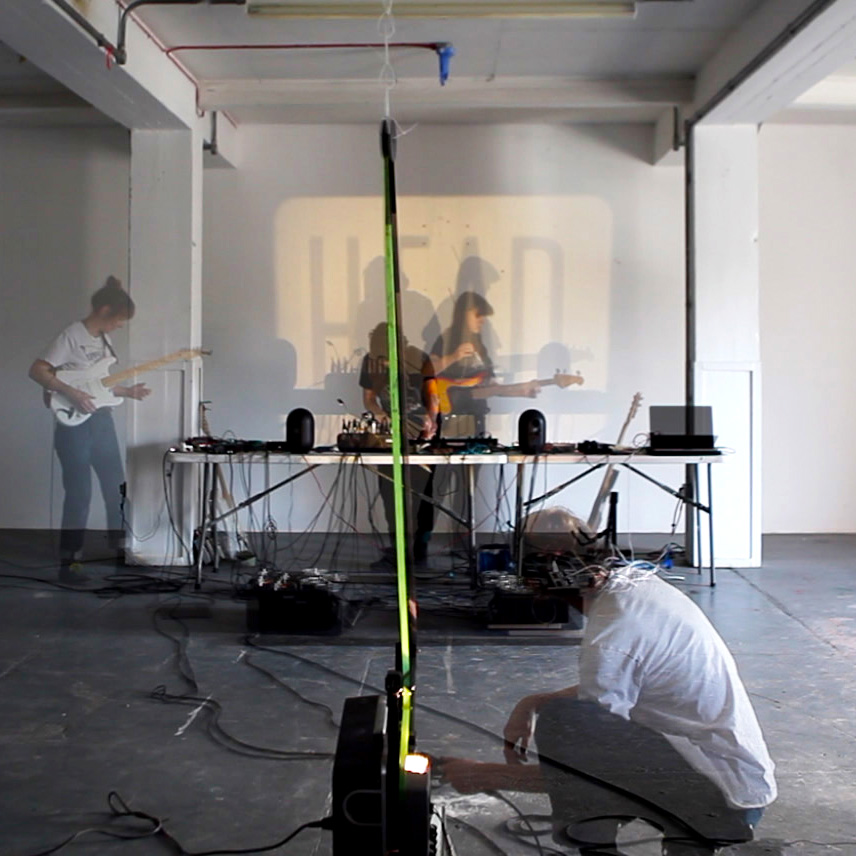
This collaborative audiovisual live performance combines reel-to-reel tape loops, minidisk players, 16mm optical film, voice, microphones, guitars, and effects. Drawing on recordings of women who devoted years to local community action, the work traces shared threads that propose alternative approaches to memory, authorship, and transmission, valuing the tactile, the collective, the imperfect, and resistant practice. The project and collaboration has grown from Bex’s research into the Women in Communism interview series recorded by Neil Rafeek, held at the National Library of Scotland’s Sound Archive.
This is an evolving system where film, light, sound and performers are in constant conversation, each affecting the other, producing a live audio-visual performance. Ideas of hindsight and time and central to the work and the constant rearranging of sound and feedback are used to experiment with ideas of archival permanence and truth.
The Super16mm optical sound film loop – a film of a previous performance – will generate sound directly from the image, as the image extends into the optical soundtrack. Looped and projected live in the performance, the film’s optical sound will be fed back into and reformatted onto magnetic tape/ reel to reel (mixed live with reel-to-reel playback). Rather than serving as a nostalgic device, the film acts as a memory tool: each iteration cycles the performance, reshaping temporal perception and sonic form. Analogue film technologies function here as active memory systems.
This process continually reshapes and recontextualises the material, allowing voices and sounds to evolve over time, generating new associations and temporal layers. Looping becomes a mechanism for transforming memory into material experience, disrupting the fixed temporality of aural archiving. Archiving is considered as conversation, as scattering, as finding a collective voice through scrapbooking, effecting found and scavenged materials, repurposing, sharing, re-editing, resharing, and revoicing each other’s words. Who gets to speak whose words and how do collective histories circulate through sound and material practice?